Engineering synthetic RNA-based condensates with tunable chemical properties
Review Article
Keywords:
Synthetic biomolecular condensates, RNA condensates, Phase separation, RNA modificationsAbstract
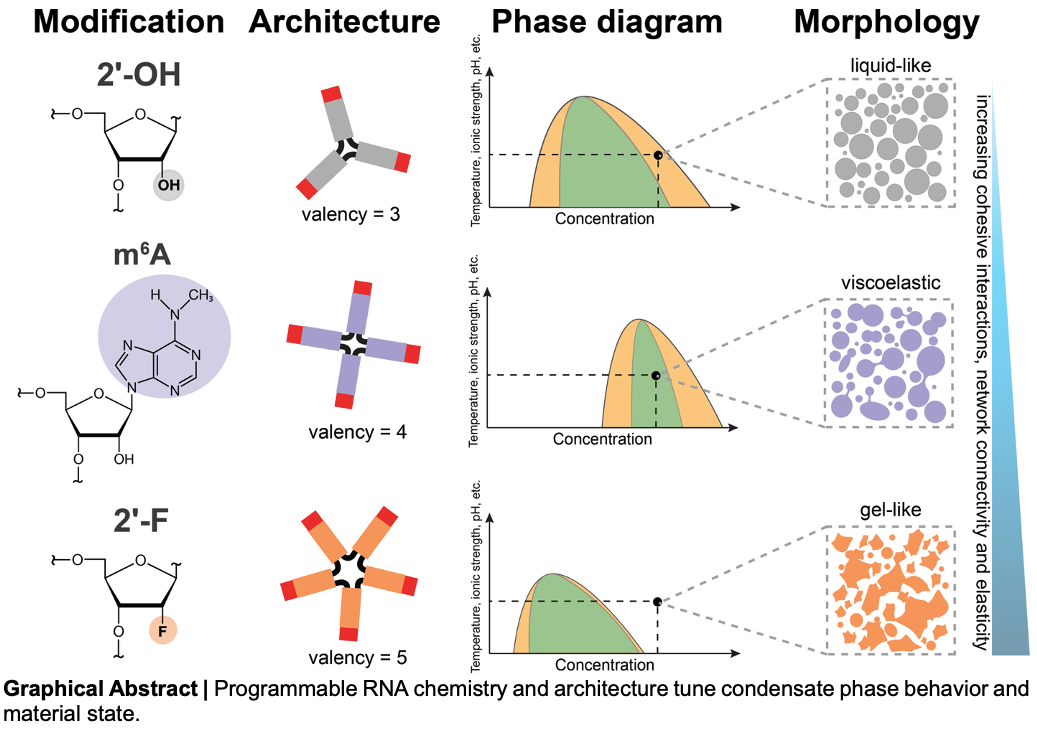
Biomolecular condensates are membraneless compartments formed through phase separation, enabling spatial control of biochemical reactions. RNA-based condensates have emerged as programmable materials whose assembly and morphology are encoded by sequence, secondary structure, and valency. This review explores the physical principles that govern RNA condensation in terms of multivalency, electrostatic screening, nucleation, and spinodal decomposition, and connects these features to condensate mechanics and material state. We further examine how natural and synthetic RNA chemical modifications may be used within engineered RNA condensates to tune stability, local structure, binding, partitioning, and transitions between liquid and gel states. Collectively, these concepts motivate emerging practical design rules for engineering RNA-based condensates with programmable dynamics, selective recruitment, and controllable material properties.
Downloads
Published
Issue
Section
License
Copyright (c) 2026 Denis Victorov, Jaimie Marie Stewart (Author)

This work is licensed under a Creative Commons Attribution 4.0 International License.