RNA Nanostructure Engineering: Optimized Design of 3-Way and 4-Way RNA Junctions for Precision Drug Delivery and RNAi-Based Cancer Therapy with Favorable Preclinical Safety Profiles
Review Article
DOI:
https://doi.org/10.59566/mfzjet97Keywords:
RNA nanotechnology, phi29 pRNA-derived nanoparticles, 3WJ/4WJ RNA scaffolds, Targeted cancer therapy, RNAi deliveryAbstract
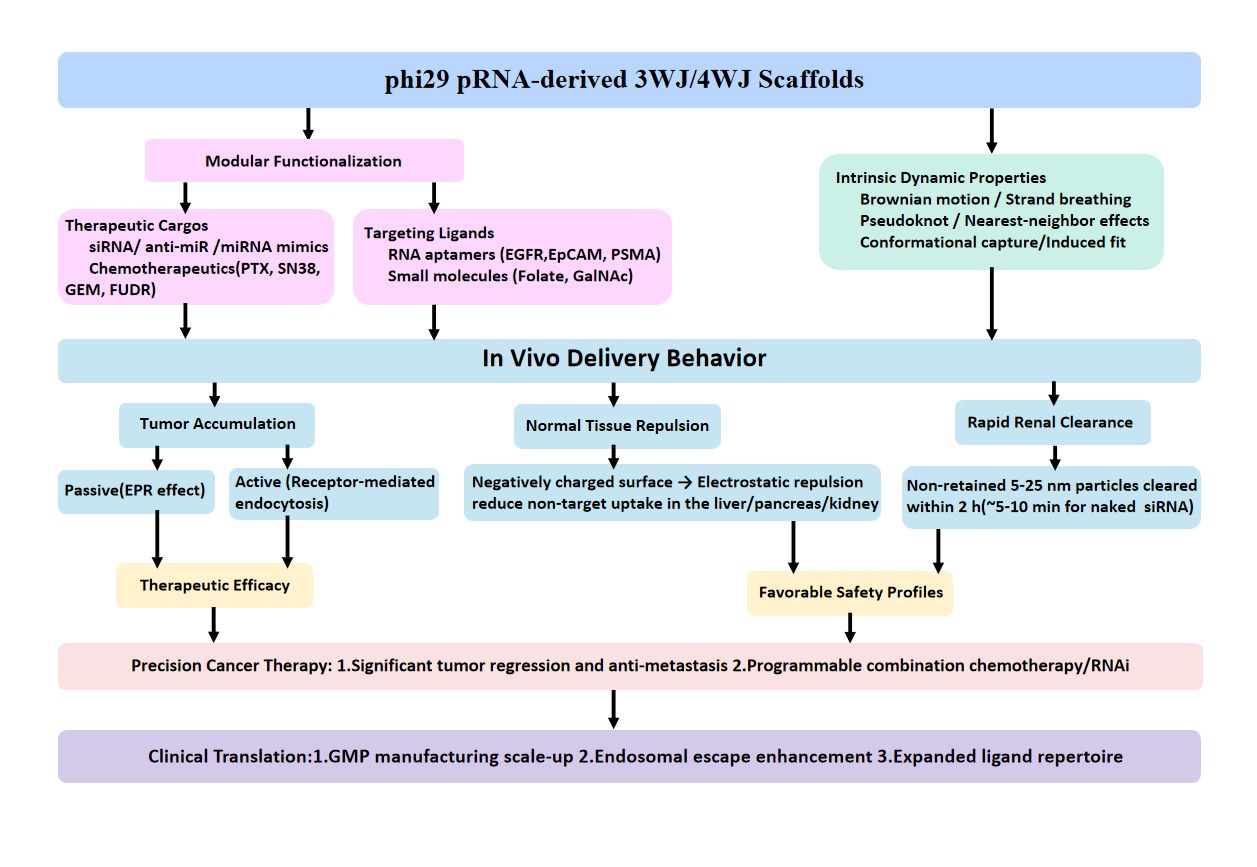
RNA nanotechnology enables the programmable assembly of nanostructures for therapeutic delivery. In the specific case of phi29 pRNA-derived nanoparticles, naturally occurring RNA motifs were first identified and then re-engineered into modular 3WJ and 4WJ scaffolds with programmable properties. Among these, phi29-derived RNA three-way junction (3WJ) and four-way junction (4WJ) motifs have emerged as stable scaffolds for constructing multifunctional nanoparticles for cancer therapy. This review summarizes the design principles, structural stability, chemical optimization, and therapeutic applications of 3WJ/4WJ-based RNA nanoparticles, with a focus on targeted delivery of small interfering RNAs, microRNA modulators, and chemotherapeutic agents. We also discuss their biodistribution and preclinical safety profiles, including rapid whole-body clearance of most 5–25 nm constructs within 2 h, undetectable organ accumulation for 5 nm particles in selected size-tuning studies, and, in a representative 4WJ-PTX system, no fatalities at a PTX-equivalent dose of 12 mg kg−1 together with undetectable or negligible cytokine induction at 5 mg kg−1. Together, these features highlight the potential of 3WJ/4WJ RNA nanoparticles as modular and precise platforms for RNA interference-based cancer treatment. This review further outlines current challenges and future directions for translating RNA nanostructures into clinically useful nanomedicines.
Downloads
Published
Issue
Section
License
Copyright (c) 2026 Zixiao Zhu, Jiena Xiao, Mingyan Liu, Junyi Lan, Ming-Zhu Xiao (Author)

This work is licensed under a Creative Commons Attribution 4.0 International License.