Exosome-Mediated HDAC9 Silencing Attenuates Tumorigenesis in Pollutant-Exacerbated Lung Cancer
Original Research Article
Keywords:
Particulate Matter 2.5 (PM2.5), Chemoresistance, Epigenetic reprogramming, HDAC9, Red blood cell-derived exosomes, Lung adenocarcinomaAbstract
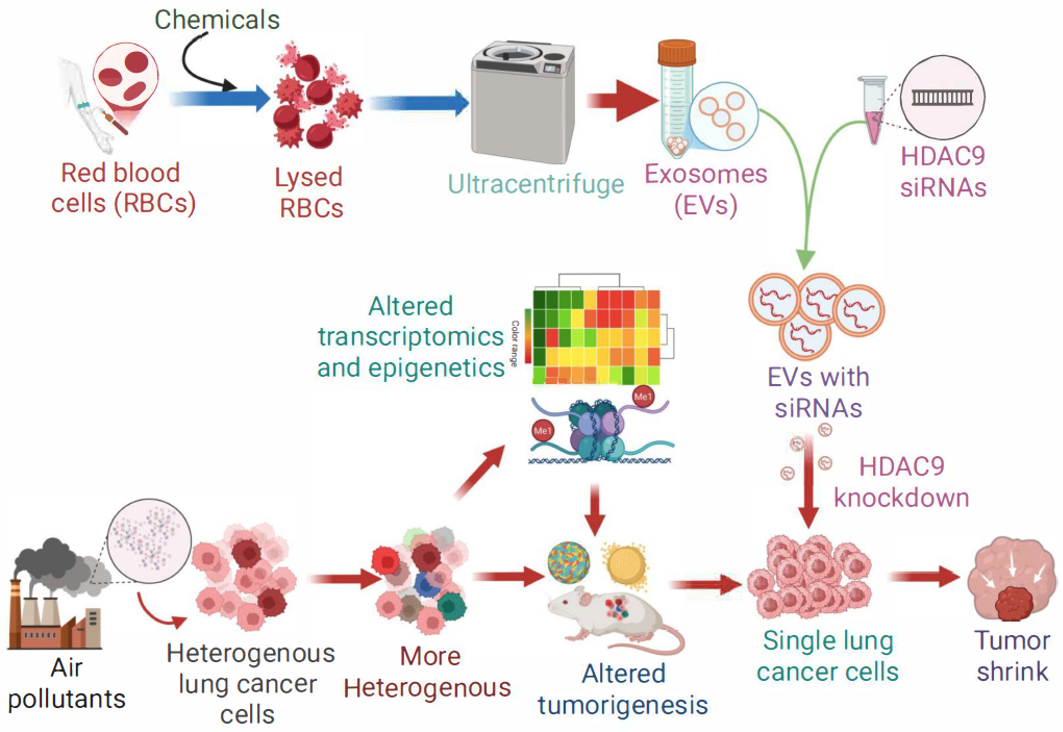
While long-term PM2.5 exposure is a known lung cancer risk factor, its impact on treatment efficacy remains understudied. Furthermore, the clinical utility of siRNA therapies is often limited by delivery hurdles. This study investigated the transcriptomic and epigenomic consequences of chronic PM2.5 exposure and evaluated a nanomedicine-based intervention for pollution-aggravated lung cancer. Our results showed that while cells maintain homeostasis under isolated exposures, synergistic chronic exposure to a human-serum- and urine-derived chemical mixture—mimicking real-world physiological internal dosimetry—enhances oncosphere and spheroid formation in vitro and accelerates tumorigenesis in vivo. Crucially, this combinatorial exposure reduced sensitivity to cisplatin, carboplatin, etoposide, and paclitaxel. Mechanistically, PM2.5 upregulated DNA methyltransferases (DNMT), increased global DNA methylation and altered promoter and gene-body methylation signatures. This drove a distinct gene expression profile characterized by the upregulation of key epigenetic regulators, most notably HDAC9. We found HDAC9 overexpression in oncospheres and tumors, where it correlated with poor survival. To overcome siRNA delivery barriers, we utilized human red blood cell-derived exosomes engineered to deliver HDAC9 siRNA. Exosomal knockdown of HDAC9 in oncosphere-derived cells impaired spheroid formation, abrogated subsequent tumor formation, and slowed proliferation (indicated by lower Ki-67 levels) in vivo. By integrating environmental factors into the molecular understanding of chemoresistance, these findings support the development of exosome-based RNA therapies for pollution-worsened lung cancers.
Downloads
Published
Issue
Section
License
Copyright (c) 2026 Sicheng Bian, Huiqin Bian, Changli Zhou, Hiroaki Koyama, Tao Cheng, Jiaxi Yan, Gail Dennison, Steffen Mueller, Alexander Miron, Ricky Chan, Bin Liu, William Tse, Shujun Liu (Author)

This work is licensed under a Creative Commons Attribution 4.0 International License.